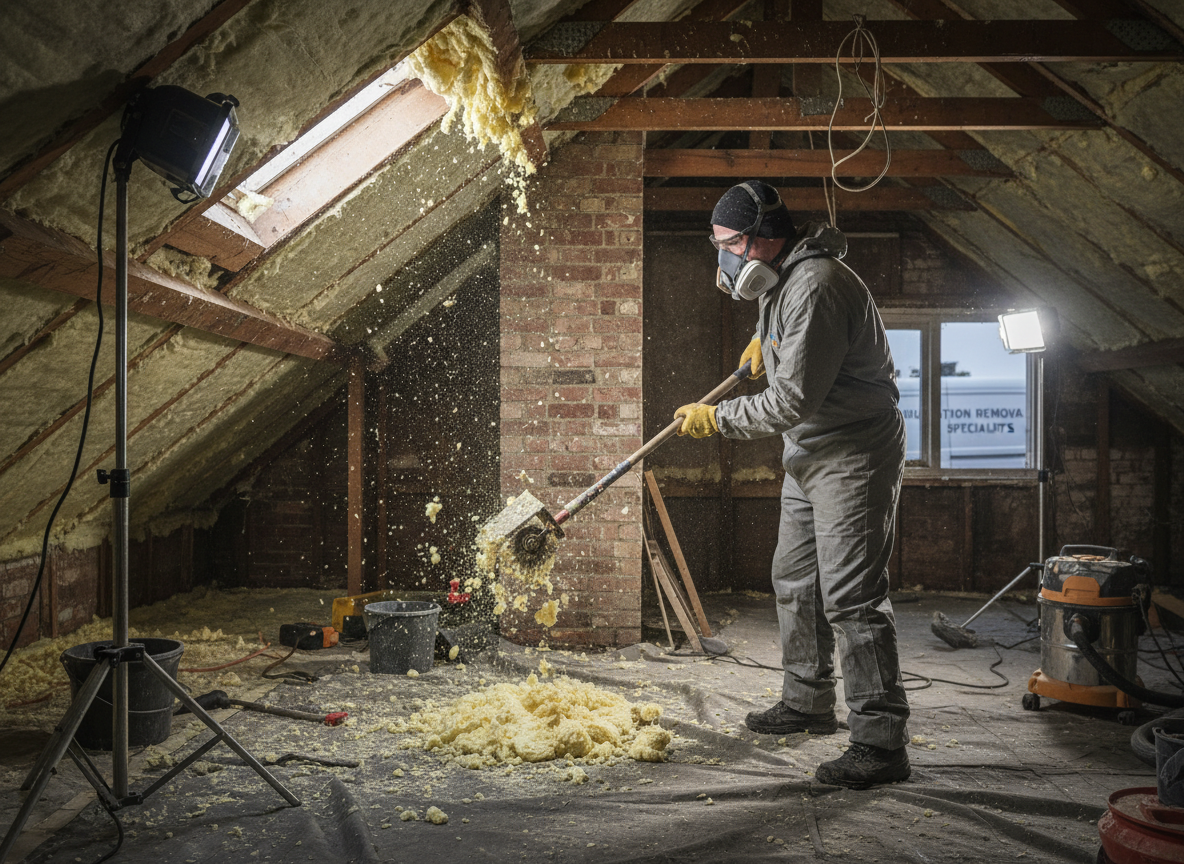
Thermal spray foam removal requires careful separation of the foam from timber joists and roof decking without damaging the original structure. In Scunthorpe properties, many lofts still contain older closed-cell foam installed over the past two decades that has begun to shrink or trap moisture against the felt. The process starts with mechanical cutting followed by solvent softening to release the bond, then vacuum extraction of residue. Homeowners often discover the foam has bridged ventilation gaps, reducing airflow along the eaves.
Edge cases arise in pre-1950s terraced houses common around the A18 corridor where narrow access hatches and low headroom complicate equipment use. Foam bonded directly to lath and plaster ceilings demands slower, lower-pressure removal to avoid cracking the ceiling below. Regulations around waste disposal in North Lincolnshire require bagged material to be taken to licensed sites rather than general landfill, adding a handling step that must be planned before work begins.
Warning signs that removal is needed include musty smells in upstairs rooms during winter and visible staining on ceiling plaster. Attempting DIY scraping often leaves thin foam layers that continue to off-gas and reduce insulation performance. Professional teams use negative-air machines to contain particles during extraction, especially important in Scunthorpe where many homes sit close together with shared rooflines.
Technician insight
In Scunthorpe, the thing that catches most people out with thermal spray foam removal is the way older closed-cell foam has been sprayed right up to the eaves in 1960s and 1970s semis along roads like Doncaster Road, completely blocking the airflow that those houses were built with.
Blocked Eaves in Gunness Terrace
Homeowner reported persistent damp patches on bedroom ceilings during winter. Inspection found thermal spray foam had filled the eaves and trapped condensation against the felt. We cut and extracted the foam in sections, restored the original ventilation gaps, and left the loft clear with no remaining residue.
How it works
- 1
Initial Loft Inspection
Assess foam type, depth, adhesion points and ventilation condition through the access hatch.
- 2
Site Preparation and Containment
Lay floor protection, seal access points and set up extraction equipment to capture dust and debris.
- 3
Foam Cutting and Softening
Score the foam into manageable sections then apply approved softening agents to release the bond from timber and felt.
- 4
Extraction and Residue Removal
Vacuum out softened foam and scrape remaining traces from joists and decking until surfaces are clean.
- 5
Final Clearance and Ventilation Check
Remove all waste, verify eaves and ridge ventilation are clear, and confirm the loft is safe for re-use.
Pricing
Upfront quotes provided after on-site loft inspection; final cost depends on foam thickness, access difficulty and volume of material.